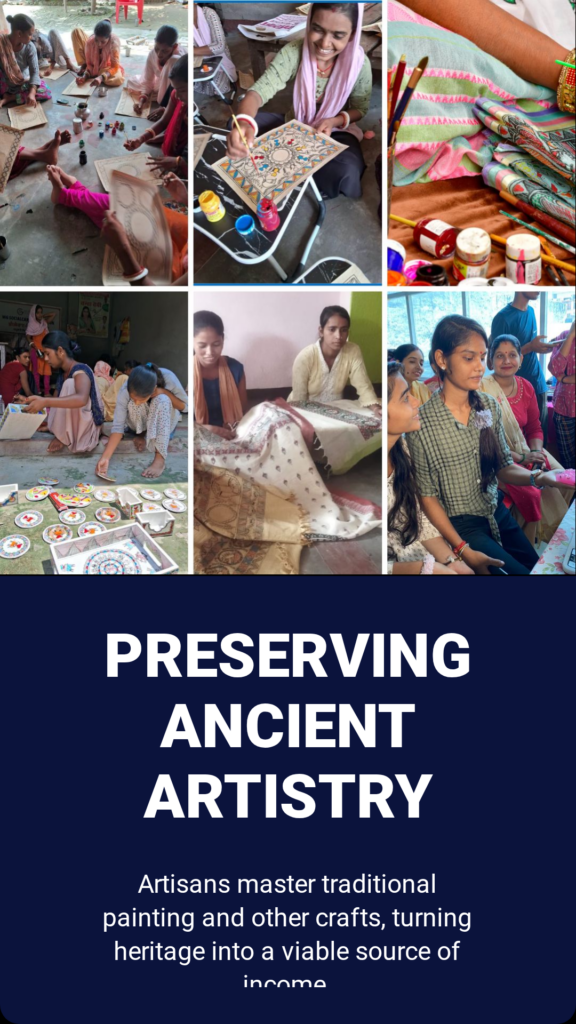
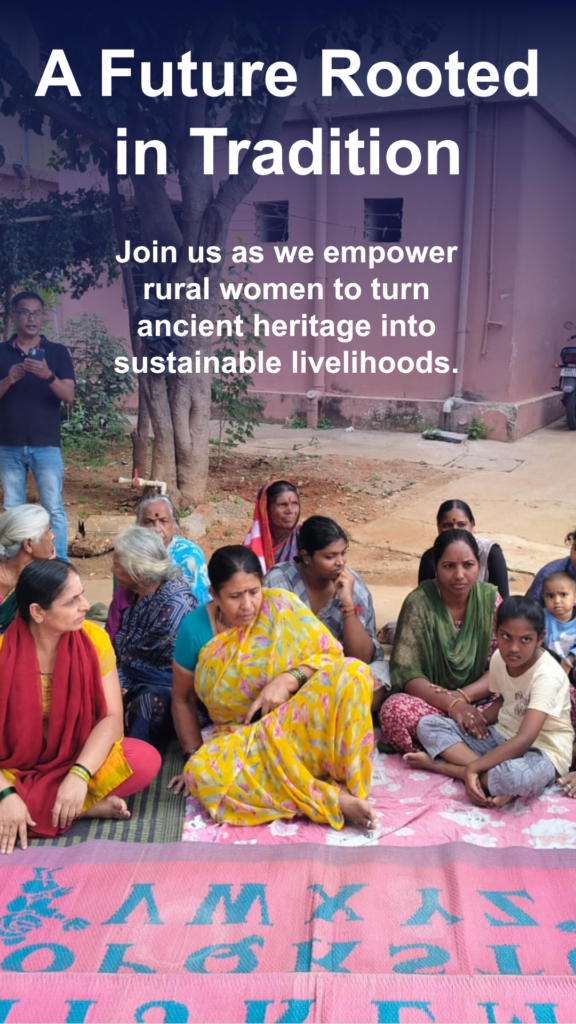
All over in India, skill development initiatives are giving support to individuals especially women and underprivileged communities in remote regions to learn novel skills. The sessions carried out at training workshops are important. However, it may be just the first step.
The real dilemma is:
What happens after the workshop ends?
At MG SocialCare Foundation, we actually believe that skill training should not be the journey’s endpoint, it must serve as launch pad for performing various activities starting with the acquisition of a skill and finishing with the production of goods, market access, income generation and gaining of independence.
Our approach can be summed up simply:
Training → Practice → Product → Market → Income → Independence
Once a person masters Madhubani painting, Batik, Tikuli art, soap making, candle making or any other skill associated with earning money, he/she acquires tremendously a useful capability. But then, is having a skill just enough?
A person may know how to make a product, but still face questions such as:
This is where the journey from training to livelihood really begins.
Starting a journey involves learning something new.
The aim of training is not just for a person to attend a workshop. Training should ultimately be about those skills that they will require for themselves and can make a good living out of.
For us, training means laying the foundations of technical knowledge, confidence and readiness to create.
And a workshop is merely the starting point in this process.
A skill is made invaluable through practice instead of theoretical knowledge.
Though the first product may not be perfect, the second one will definitely be better than the first. With regular practice, participants understand what quality, finishing or design means.
This is the stage that is often ignored.
Training gives you knowledge. Practice gives you confidence.
The more a person is practicing, the better they become good at their work.
The next transition is to switch from learning a skill to producing a product. This is a significant transformation in mindset.
A painting, homemade soap, candle, textile product, and craftsmanship are not merely things made during training; if they are produced in a quality way and are properly marketed, they become marketable products.
Participants should realize what is important for customers—design, quality, practicality, uniqueness, detailing, and marketing.
This is where creativity starts meeting opportunity.
Market access is the hardest problem, maybe harder than skill training.
You can train hundreds of people, but if there is no pathway to the customer, you still can’t create sustainable livelihoods.
A skilled artisan needs to have access to markets, local, institutional, digital and, where possible, national and international.
Today social media, e-commerce and digital platforms are creating new opportunities for small producers and artisans. But it takes more than a product to tap into these opportunities.
It needs to be understood:
Product + Pricing + Packaging + Branding +Storytelling + Market Access
This is why livelihood-oriented skill development needs to think beyond the workshop.
This is the crucial time when the impact becomes tangible.
The goal is not simply to state:
“She acquired training.” Rather, the much more compelling question is:
Such results tell us far more about the efficiency of skill acquisition than the number of participants of a program.
Money matters. But independence is the larger goal.
If a woman can turn her skills into money, she gets more than the financial value out of it.
This is very important: we need to think about social impact.
A beneficiary receives support. A skilled individual has the potential to create value.
Our goal is to support our beneficiaries along that journey.
We don’t want the story to end with:
“The training was successfully completed.”
We want the story to continue:
“She learnt.”
“She practised.”
“She created.”
“She sold.”
“She earned.”
“She became more independent and confident.”
That is when training starts becoming impact.
For any skill development programs initiated by us, we consider livelihood creation as a longer process.
It requires patience, regular practice, mentorship, access to markets and opportunities to display and sell products.
It also requires partnerships and collaborations.
Corporates, CSR teams, NGOs, institutions, marketplaces and consumers can all play a role in creating this ecosystem.
Because ultimately, a skilled person also needs an opportunity.
Our work in livelihood-oriented skills and traditional arts at MG SocialCare Foundation is driven by the following straightforward principle:
Opportunities should be created by skills.
The goal is more than just teaching a skill, be it traditional paintings or creating handmade items . It is to make it possible for people to apply what they have learnt.
Additionally, that skill has the potential to become a source of income when it interacts with a market.
For this reason, our philosophy is:
We Enable Skills. They Create Impact.
Scan the code to donate and support MG SocialCare Foundation’s mission

©2026 MG SocialCare Foundation All Rights Reserved

